
Human beings are creatures of habits, good or bad. They control our lives as they form the people we are, the things we believe in and the personalities we portray. Our subconscious minds are programmed by what is repeated daily, and they store and use this information to create thoughts that lead to feelings, which lead to actions and eventually to results.
We all have bad habits that we wish to get rid of but feel pessimistic about doing so. Maybe you know you really have to spend less time on Facebook or playing online games. Or perhaps you’ve tried a dozen times to quit smoking. Or maybe even thinking about getting more exercise makes you feel too tired to start. Whatever habit you’re trying to break, somehow you haven’t found the key to success.

Bad habits interrupt your life and prevent you from accomplishing your goals. They jeopardise your health, both mentally and physically. And they waste your time and energy. So why do we still do them? And most importantly, is there anything you can do about it?
Habits are hard to break because, well, they are habits. Breaking bad habits takes time and effort, but mostly it takes perseverance.
Most people who end up breaking bad habits have failed multiple times before they succeeded. You might not have success right away, but that doesn’t mean you can’t have it at all.
We all get fascinated by transformations and overnight success. Who wouldn’t want to be more successful in less time? The problem about dramatic transformations is that we only know about the event but not about the process of transformation or habits that lead to the eventual results. It is natural to think we need the results, the transformation or the overnight success. However, what we actually need are better habits that will support process of success.
Your life today is a result of your daily habits. Your bank balance is a result of your financial habits and your fitness level is a measure of your workout and eating habits. Almost every habit you have, good or bad, is a result of many small decisions over time. So, if the problems you are facing are the result of small decisions made over time, the path to success and prosperity would also be through small daily decisions. Achieving success in life is about daily process you follow and not the ultimate product you achieve. Do not focus on the result but on the habits and routines.
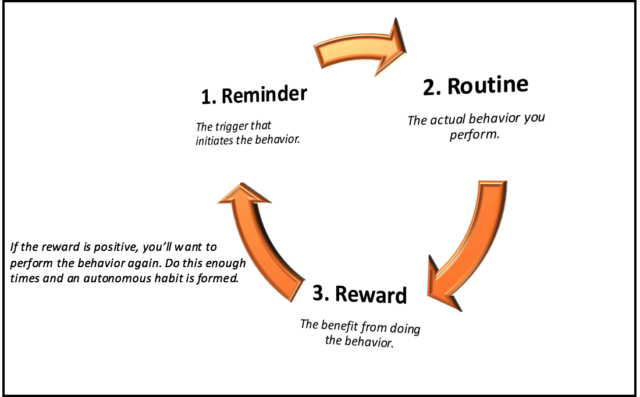
There is a simple 3-step pattern that every habit follows, and it goes like this:
- Reminder – the trigger that initiates the behaviour;
- Routine – the behaviour itself, the action you take, and;
- Reward – the benefit you gain from doing the behaviour.
Below is an example of answering your phone, showing how this pattern works in real life.
Step One: Your phone rings (reminder). This initiates behaviour and acts as a trigger that tells you to answer the phone.
Step Two: You answer your phone (routine). This is the actual behaviour that you do when your phone rings.
Step Three: You find out who is calling (reward). This is the benefit gained from doing the behaviour.
If the reward is positive, the cycle forms a positive feedback loop that tells your subconscious mind to do the same next time when your phone rings. If you follow the same cycle enough times, your behaviour will become a habit.
You can use this 3-step pattern to create new habits.
Step One: Use a current habit as a reminder for your new habit
Set up a visible reminder and link your new habit with a current behaviour to make it easier to change. The best way to discover a good reminder for your new habit is to write down two lists.
One: Write down things you do each day without fail. E.g. making your bed, taking a shower, brushing your teeth, putting on clothes, driving to work, eating supper, getting into bed, etc. If you want to develop a reading habit, you may use “getting into bed” habit as a reminder to read at least 10 pages of a book before sleeping.
Two: Write down things that happen to you each day. E.g. stopping at a traffic light, receiving a text message, seeing commercial ad on TV, etc. so, when you see a commercial ad on TV while watching your favourite program, put the book you want to read next to your bed.
Step Two: Make your habits incredibly easy to start
Almost every habit you have, good or bad, is a result of many small decisions over time. So, if you want to start a new habit and begin living healthier and happier, start small. Make the process so easy that you can’t say no.
In the book called “I ran for my life” by Kabelo Mabalane, Dr. Ross Tucker, an exercise physiologist and high performance sports consultant, suggests that a 12-Week, 10km run training programme starts with five daily sessions of 1-minute run and 3-minute walk on day one.

In the beginning, performance doesn’t matter. What matters is becoming the person who always sticks to the new habit, no matter how small or insignificant it seems. You can build up the desired performance level once the behaviour becomes consistent. So, pick up a new habit you want to start and ask yourself: “How can I make this new behaviour so easy that I can’t say no?”
Step Three – Always reward yourself
It’s important to celebrate. If you want to stick to new habits, mix them with things that make you feel good. Reward yourself with positive self-talk that can take some getting used to if you are not someone who typically does that. Reward is an important part of the habit process. Give yourself some credit and enjoy each small success.
Important Note: Make sure that your new habits are important to you. It’s tough to find a reward in something when you are only doing it because you think other people expect it or would approve of it. This is your life, make sure you spend your time on things that are important to you.

Changing your beliefs isn’t nearly as hard as you might think. Just decide the type of the person you want to be and prove it to yourself with small wins. The process of long-term success relies heavily on becoming the person that can consistently take small steps for an extended period of time. Example, a person who works out consistently is a person who can become strong. So, to become a strong person, develop the identity of someone who works out first, and move to performance and appearance later. Start small and trust that the results will come as develop a new identity.
To run a marathon, you must first become a runner. To read a book, you must first become a reader. To be financially free, you must become an financially savvy. All these are achieved by consistently doing a few simple things over an extended period of time. If you are serious about sticking to your new habits, you have to start small.
Check out How To Start New Habits That Actually Stick, and I also highly recommend the book called Atomic Habits by James Clear for more on how to change your habits.
Thank you for being part of the Design Your Tomorrow family and please leave your comment below about this post.
“THE BEST WAY TO DESIGN YOUR OWN TOMORROW IS BY CONTINUOUSLY INVESTING IN YOURSELF THROUGH EDUCATION”.